Which of These Animals Is the Largest Member of the Dog Family?
Dog Family unit: Facts About Canines & Their Cousins
Dogs and humans have been best friends for thousands of years. Researchers know that dogs regularly lived with humans by about ten,000 years ago, and dogs and people are establish buried together every bit early equally 14,000 years agone. And for even longer, perhaps hundreds of thousands of years, humans walked alongside the canis familiaris's antecedent, an extinct species of wolf.
Domestic dogs and wolves are role of a large taxonomic family called Canidae, which also includes coyotes, foxes and jackals, according to the Integrated Taxonomic Information System (ITIS). Members of this family are chosen canids. Domestic dogs are a subspecies chosen Canis lupus familiaris. [Related: How Did Dogs Go to Exist Dogs?]
Size
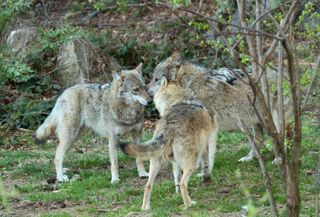
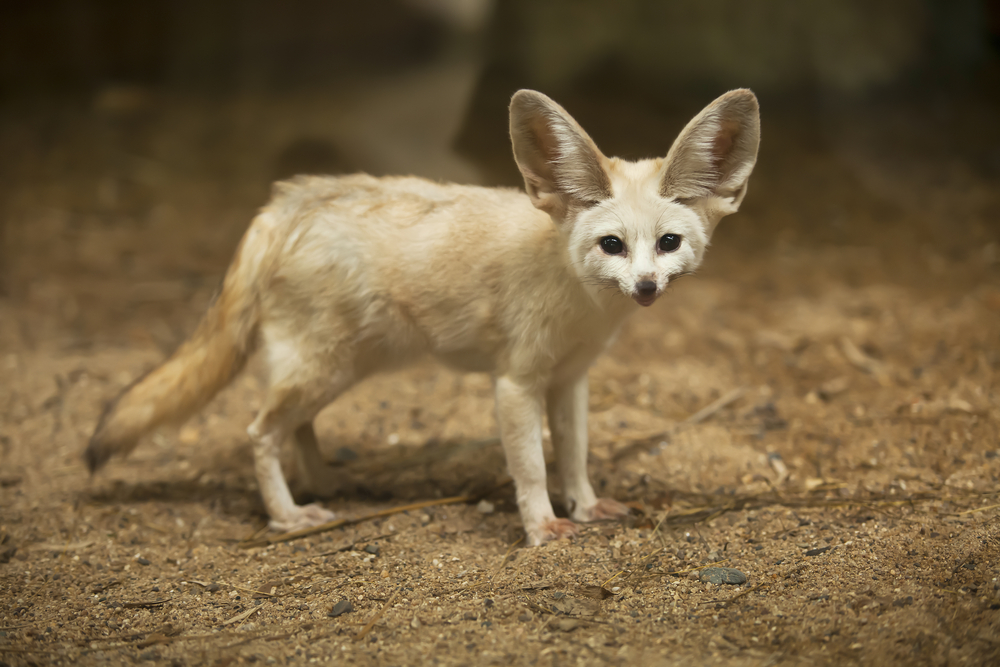
The Canidae family includes xiv genera and 34 species, according to the University of Michigan's Creature Diverseness Web. With such variety, it is easy to meet why at that place are so many dissimilar sizes of dogs. According to the University of Edinburgh, the smallest canid is the Fennec play tricks. It is only 9.4 inches (24 centimeters) high and weighs merely ii.2 lbs. (1 kilogram). The largest canid is the gray wolf, at 6.five feet (200 cm) high and 3 to 5 feet (1 to 1.v meters) long. Their tails add together an additional one to 2 anxiety. Females typically weigh 60 to 100 lbs., and males weigh 70 to 145 lbs., according to the National Wildlife Federation.
Habitat
Canids are institute all over the earth. Coyotes roam North America's forests and mountains. Scarlet foxes live in grasslands, forests, mountains and deserts in the Northern Hemisphere, co-ordinate to National Geographic. Jackals are found in the savannas, deserts, and barren grasslands of Africa. Wolves live on every continent in the Northern Hemisphere.
Habits
Canids are typically social and travel in groups called packs. They are very territorial, though, and mark their territory with scent marking. Even domesticated dogs will marker their yards by leaving their odour on trees, bushes and objects.
Jackals are a little less social and usually travel in pairs, according to the African Wild animals Foundation. Males and females mate for life, which is very rare for mammals.
Wolves, foxes and other dogs don't howl at the moon. They are actually howling at each other every bit a class of communication. Dogs also yelp, whine, bark and growl to communicate.
It is a myth that domesticated dogs only see black and white. They are really red-greenish colorblind, according to a small-scale 2017 Italian study on 16 dogs. "If you are planning to train your dog to fetch a brawl that fell on the green grass of your garden, think of using a blue, and not cherry, ball," said report lead researcher Marcello Siniscalchi, a professor in the department of veterinary medicine at the Academy of Bari, in Italy. This is most probable due to the fact that dogs have evolved from creatures that hunted during dusk and dawn, which doesn't crave colour vision. [Doggone: Your All-time Friend Is Red-Light-green Colorblind]
Domestic dogs are besides very expressive in their facial expressions, peculiarly when they are getting attention from humans, co-ordinate to a 2017 study published in the journal Scientific Reports.
"The findings appear to support evidence [that] dogs are sensitive to humans' attention and that [their] expressions are potentially active attempts to communicate, non unproblematic emotional displays," lead study writer Juliane Kaminski, a senior lecturer in psychology and leader of the Dog Cognition Centre at the Academy of Portsmouth in England, said in a statement. "Domestic dogs accept a unique history — they have lived alongside humans for 30,000 years, and during that time, selection pressures seem to have acted on dogs' ability to communicate with united states."
Diet
Though dogs are omnivores, they swallow mostly meat and are built-in killers. They accept not-retractable claws, long legs for speed and teeth that are precipitous, pointed and perfect for tearing at meat. Wolves, for example, eat deer, domestic livestock, caribou, beaver, moose and hares. Jackals eat smaller fare such every bit rodents, immature gazelle, rabbits and monkeys.
Dogs also have well-adult carnassial molars, upper and lower teeth that are paired and have flat edges that permit self-sharpening when they pass by each other. According to the University of Illinois at Urbana-Champaign, these teeth are used to beat vegetation such equally fruits and grasses.
Offspring
All members of the Canidae family unit have live births after a gestation period of 45 to 55 days. Canids typically have many babies at once. Domestic dogs can have as many as fifteen young, called pups, at the same time. Other genus types are less prolific. For example, gray foxes (genus Urocyon) have only one to seven young per year, according to the University of Illinois at Urbana-Champaign. The Biological Sciences Section of Smith Higher reports that there is a correlation betwixt the weight of a canid and reproduction; the larger the female, the larger the litter size.
Classification/Taxonomy
The taxonomy of dogs, according to ITIS, is:
Kingdom: Animalia Subkingdom: Bilateria Infrakingdom: Deuterostomia Phylum: Chordata Subphylum: Vertebrata Infraphylum: Gnathostomata Superclass: Tetrapoda Class: Mammalia Bracket: Theria Infraclass: Eutheria Guild: Carnivora Suborder: Caniformia Family: Canidae Genera & species:
- Atelocynus microtis — short-eared domestic dog, small-eared domestic dog, pocket-sized-eared zorro
- Canis adustus — side-striped jackal
- Canis aureus — golden jackal
- Canis latrans — coyote
- Canis lupus — wolf, greyness wolf (Subspecies: Canis lupus familiaris — dog)
- Canis mesomelas — black-backed jackal
- Canis simensis — simian jackal, simian fox, Ethiopian wolf
- Cerdocyon thous — crab-eating trick
- Chrysocyon brachyurus — maned wolf Cuon alpinus — dhole, Indian dhole, Asiatic wild dog, red dog
- Dusicyon australis — Falkland Island wolf, Falkland Islands wolf
- Lycalopex culpaeus — culpeo
- Lycalopex fulvipes — Darwin'due south trick
- Lycalopex griseus — S American grey fox
- Lycalopex gymnocercus — pampas play a trick on
- Lycalopex sechurae — Sechuran fox
- Lycalopex vetulus — hoary fob
- Lycaon pictus — African hunting dog, African wild dog
- Nyctereutes procyonoides — raccoon canis familiaris
- Otocyon megalotis — bat-eared fox, big-eared pull a fast one on
- Speothos venaticus — bush-league dog
- Urocyon cinereoargenteus — grey fob, common greyness play tricks
- Urocyon littoralis — island fox, isle gray fox, Aqueduct Islands greyness fox
- Vulpes bengalensis — bengal play a joke on
- Vulpes cana — Blanford's play tricks
- Vulpes chama — cape fox
- Vulpes corsac — corsac pull a fast one on
- Vulpes ferrilata — Tibetan fox, Tibetan sand fob
- Vulpes lagopus — bluish play a trick on, water ice flim-flam, polar play tricks, white play a joke on, Chill flim-flam
- Vulpes macrotis — kit pull a fast one on
- Vulpes pallida — pale trick
- Vulpes rueppellii — Rüppell's fox
- Vulpes velox — swift fox
- Vulpes vulpes — cerise play a joke on
- Vulpes zerda — fennec, fennec play a joke on
Conservation status
The International Union for Conservation of Nature (IUCN) has many dogs on its Red List of Threatened Species.
Near threatened (generally due to small geographical range and habitat loss) are the short-eared dog (Atelocynus microtis), maned wolf (Chrysocyon brachyurus), Sechuran fox (Lycalopex sechurae), island fob (Urocyon littoralis) and bush-league dog (Speothos venaticus).
Darwin's fox (Lycalopex fulvipes) — with a population of 659 to two,499 mature individuals; the African wild dog (Lycaon pictus) — just 1,400 mature individuals; the dhole(Cuon alpinus) — 949 to ii,215 mature individuals; and the Ethiopian wolf (Canis simensis) — simply 197 mature individuals — are endangered.
The reddish wolf (Canis rufus) is critically endangered. The species was extinct in the wild by 1980, and only exists now in a reintroduced population in eastern North Carolina. The total population is less than 150 individuals — and no more than than 50 are mature.
The Falklands wolf (Dusicyon australis) has been extinct since 1876.
Other facts
The life span of a dog varies, depending on what type it is. Wolves, coyotes, jackals and domestic dogs alive 10 years or more. Vulpes, or true foxes, alive around five years.
Coyotes are scavengers that will consume almost anything. Their diet includes bugs, trash, deer, rodents and snakes. They are also very fast runners and tin can stitch to 40 mph (64 km/h), according to National Geographic.
The lead male and female person are the only 2 that typically breed in a wolf pack. Their hierarchy is very strict. A pack is ordinarily lead by a dominant male.
Dogs tin go the flu. [Coughing Canines? vi Things to Know About Dog Influenza]
Additional resources
- Encyclopedia of Life: Canidae
- University of Illinois at Urbana–Champaign: Family Canidae
- African Wild fauna Federation: African Wild Dogs

Alina Bradford is a contributing writer for Live Science. Over the by 16 years, Alina has covered everything from Ebola to androids while writing wellness, science and tech articles for major publications. She has multiple health, safety and lifesaving certifications from Oklahoma Country Academy. Alina's goal in life is to endeavour equally many experiences as possible. To date, she has been a volunteer fire fighter, a dispatcher, substitute teacher, artist, janitor, children's book author, pizza maker, event coordinator and much more than.
Source: https://www.livescience.com/50471-dog-family-facts-about-canines-their-cousins.html
Belum ada Komentar untuk "Which of These Animals Is the Largest Member of the Dog Family?"
Posting Komentar