How Can You Determine the Quality of the Nursing Research
Know the concepts behind writing NANDA nursing diagnosis in this ultimate tutorial and nursing diagnosis listing. Larn what is a nursing diagnosis, its history and evolution, the nursing process, the different types, its classifications, and how to write NANDA nursing diagnoses correctly. Included as well in this guide are tips on how you tin can formulate ameliorate nursing diagnoses plus guides on how y'all can apply them in creating your nursing intendance plans.
Table of Contents
- What is a Nursing Diagnosis?
- Purposes of Nursing Diagnosis
- Differentiating Nursing Diagnoses, Medical Diagnoses, and Collaborative Bug
- NANDA International (NANDA-I)
- History and Evolution of Nursing Diagnosis
- Classification of Nursing Diagnoses (Taxonomy II)
- Nursing Process
- Types of Nursing Diagnoses
- Trouble-Focused Nursing Diagnosis
- Risk Nursing Diagnosis
- Wellness Promotion Diagnosis
- Syndrome Diagnosis
- Possible Nursing Diagnosis
- Components of a Nursing Diagnosis
- Problem and Definition
- Etiology
- Risk Factors
- Defining Characteristics
- Diagnostic Procedure: How to Diagnose
- Analyzing Data
- Identifying Health Problems, Risks, and Strengths
- Formulating Diagnostic Statements
- How to Write a Nursing Diagnosis?
- PES Format
- I-Part Nursing Diagnosis Statement
- Two-Part Nursing Diagnosis Statement
- Three-office Nursing Diagnosis Statement
- PES Format
- Nursing Diagnosis for Care Plans
- References and Sources
What is a Nursing Diagnosis?
A nursing diagnosis is a clinical judgment apropos human response to wellness conditions/life processes, or a vulnerability for that response, past an individual, family unit, group, or community. A nursing diagnosis provides the ground for the pick of nursing interventions to accomplish outcomes for which the nurse has accountability.Nursing diagnoses are developed based on data obtained during the nursing assessment and enable the nurse to develop the intendance programme.
Purposes of Nursing Diagnosis
The purpose of the nursing diagnosis is every bit follows:
- Helps identify nursing priorities and help direct nursing interventions based on identified priorities.
- Helps the conception of expected outcomes for quality assurance requirements of third-party payers.
- Nursing diagnoses help identify how a client or group responds to bodily or potential health and life processes and knowing their available resources of strengths that can be drawn upon to prevent or resolve issues.
- Provides a common linguistic communication and forms a ground for communication and understanding between nursing professionals and the healthcare squad.
- Provides a basis of evaluation to determine if nursing care was beneficial to the client and cost-effective.
- For nursing students, nursing diagnoses are an effective educational activity tool to assist sharpen their problem-solving and critical thinking skills.
Differentiating Nursing Diagnoses, Medical Diagnoses, and Collaborative Issues
The term nursing diagnosis is associated with 3 unlike concepts. It may refer to the distinct second footstep in the nursing process, diagnosis. Also, nursing diagnosis applies to the label when nurses assign meaning to nerveless information appropriately labeled with NANDA-I-approved nursing diagnosis. For instance, during the cess, the nurse may recognize that the client is feeling anxious, fearful, and finds it hard to sleep. It is those problems that are labeled with nursing diagnoses: respectively, Anxiety, Fear, and Disturbed Sleep Pattern. Lastly, a nursing diagnosis refers to one of many diagnoses in the nomenclature system established and approved by NANDA. In this context, a nursing diagnosis is based upon the response of the patient to the medical status. It is called a 'nursing diagnosis' because these are matters that hold a singled-out and precise activity that is associated with what nurses have the autonomy to take action about with a specific disease or condition. This includes anything that is a physical, mental, and spiritual type of response. Hence, a nursing diagnosis is focused on intendance.
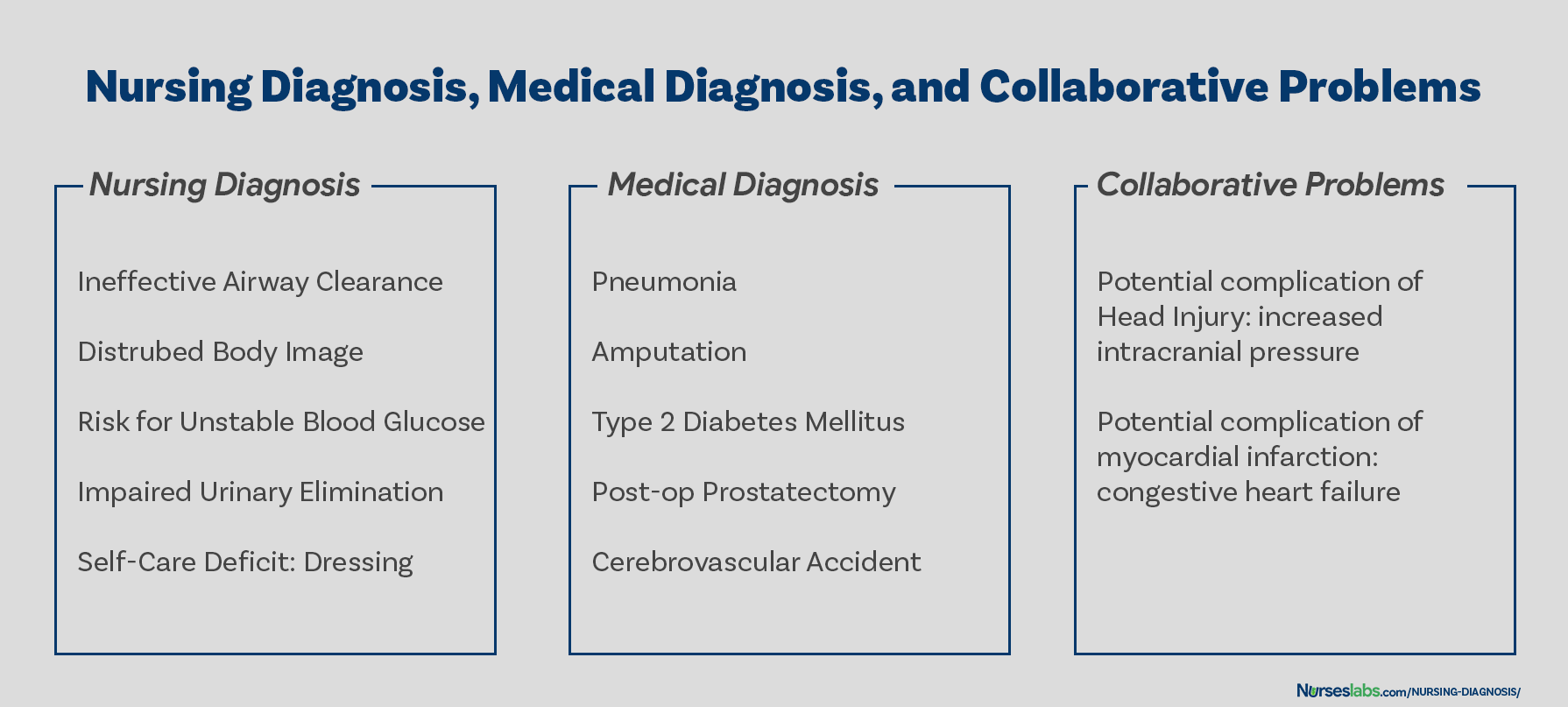
A medical diagnosis, on the other hand, is made by the physician or advanced health care practitioner that deals more with the disease, medical condition, or pathological country simply a practitioner can care for. Moreover, through feel and know-how, the specific and precise clinical entity that might be the possible cause of the affliction volition so be undertaken by the physician, therefore, providing the proper medication that would cure the affliction. Examples of medical diagnoses are Diabetes Mellitus, Tuberculosis, Amputation, Hepatitis, and Chronic Kidney Disease.The medical diagnosis normally does non change. Nurses are required to follow the physician's orders and carry out prescribed treatments and therapies.
Collaborative issues are potential issues that nurses manage using both independent and physician-prescribed interventions. These are bug or weather condition that require both medical and nursing interventions with the nursing attribute focused on monitoring the client's condition and preventing the development of the potential complexity.
Every bit explained above, now information technology is easier to distinguish a nursing diagnosis from that of a medical diagnosis. Nursing diagnosis is directed towards the patient and his physiological and psychological response. A medical diagnosis, on the other hand, is detail with the disease or medical status. Its center is on the illness.
NANDA International (NANDA-I)
NANDA – International earlier known as the Northward American Nursing Diagnosis Association (NANDA) is the main system for defining, distribution and integration of standardized nursing diagnoses worldwide.
The term nursing diagnosis was first mentioned in the nursing literature in the 1950s. Ii faculty members of Saint Louis Academy, Kristine Gebbie and Mary Ann Lavin, recognized the need to identify nurses' role in an ambulatory care setting. In 1973, NANDA'due south first national conference was held to formally identify, develop, and classify nursing diagnoses. Subsequent national conferences occurred in 1975, in 1980, and every two years thereafter. In recognition of the participation of nurses in the Us and Canada, in 1982 the grouping accepted the proper name North American Nursing Diagnosis Association (NANDA).
In 2002, NANDA became NANDA International (NANDA-I) in response to its significant growth in membership outside of North America. The acronym NANDA was retained in the name considering of its recognition.
Review, refinement, and enquiry of diagnostic labels continue as new and modified labels are discussed at each biennial conference. Nurses can submit diagnoses to the Diagnostic Review Committee for review. The NANDA-I lath of directors gives the final approval for incorporation of the diagnosis into the official listing of labels. Every bit of 2021, NANDA-I has canonical 267 diagnoses for clinical employ, testing, and refinement.
History and Evolution of Nursing Diagnosis
In this section, we'll look at the events that led to the evolution of nursing diagnosis today:
- The need for nursing to earn its professional person status, the increasing use of computers in hospitals for accreditation documentation, and the demand for a standardized linguistic communication from nurses lead to the development of nursing diagnosis.
- Post-World State of war II America saw an increment in the number of nurses returning from armed forces service. These nurses were highly skilled in treating medical diagnoses with physicians. Returning to peacetime practice, nurses were faced with renewed domination by physicians and social pressures to return to traditionally defined female roles with reduces status to make room in the workforce for returning male person soldiers. With that, nurses felt increased pressure to redefine their unique condition and value.
- Nursing diagnosis was seen equally the approach that could provide the "frame of reference from which nurses could determine what to do and what to expect" in a clinical practice state of affairs.
- Nursing diagnoses were also intended to define nursing'south unique boundaries with respect to medical diagnoses. For NANDA, the standardization of nursing language through nursing diagnosis was the first step towards having insurance companies pay nurses directly for their care.
- In 1953, Virginia Fry and R. Louise McManus introduced the subject field-specific term "nursing diagnosis" to describe a step necessary in developing a nursing care plan.
- In 1972, the New York State Nurse Practice Act identified diagnosing as part of the legal domain of professional nursing. The Human action was the get-go legislative recognition of nursing's independent role and diagnostic function.
- In 1973, the development of nursing diagnosis formally began when two faculty members of the Saint Louis Academy, Kristine Gebbie and Mary Ann Lavin, perceived a need to identify nurses' roles in ambulatory care settings. In the same yr, the offset national conference to identify nursing diagnoses was sponsored by the Saint Louis University Schoolhouse of Nursing and Centrolineal Wellness Profession in 1973.
- Besides in 1973, the American Nurses Association's Standards of Practice included diagnosing as a function of professional nursing. Diagnosing was subsequently incorporated into the component of the nursing process. The nursing process was used to standardize and define the concept of nursing care, hoping that it would aid to earn professional status.
- In 1980, the American Nurses Association (ANA) Social Policy Statement defined nursing every bit: "the diagnosis and treatment of human response to actual or potential health issues."
- International recognition of the conferences and the evolution of nursing diagnosis came with the First Canadian Conference in Toronto (1977) and the International Nursing Conference (1987) in Alberta, Canada.
- In 1982, the briefing group accepted the proper noun "North American Nursing Diagnosis Clan (NANDA)" to recognize the participation and contribution of nurses in the United States and Canada. In the same twelvemonth, the newly formed NANDA used Sr. Callista Roy's "9 patterns of unitary man" equally an organizing principle since the commencement taxonomy listed nursing diagnosis alphabetically – which was deemed unscientific.
- In 1984, NANDA renamed "patterns of unitary man" equally "human response patterns" based on the work of Marjorie Gordon. Currently, the taxonomy is now chosen Taxonomy 2.
- In 1990 during the 9th conference of NANDA, the group approved an official definition of nursing diagnosis:
"Nursing diagnosis is a clinical judgment near individual, family unit, or community responses to bodily or potential wellness issues/life processes. Nursing diagnosis provides the basis for choice of nursing interventions to achieve outcomes for which the nurse is accountable." - In 1997, NANDA changed the name of its official journal from "Nursing Diagnosis" to "Nursing Diagnosis: The International Journal of Nursing Terminologies and Classifications."
- In 2002, NANDA changed its name to NANDA International (NANDA-I) to further reflect the worldwide interest in nursing diagnosis. In the aforementioned year, Taxonomy II was released based on the revised version of Gordon's Functional health patterns.
- As of 2018, NANDA-I has approved 244 diagnoses for clinical apply, testing, and refinement.
- As of 2021, there are 267 approved diagnoses for clinical utilize, testing, and refinement.
Nomenclature of Nursing Diagnoses (Taxonomy 2)
How are nursing diagnoses listed, arranged, or classified? In 2002, Taxonomy 2 was adopted, which was based on the Functional Health Patterns assessment framework of Dr. Mary Joy Gordon. Taxonomy Two has three levels: Domains (xiii), Classes (47), and nursing diagnoses. Nursing diagnoses are no longer grouped by Gordon's patterns simply coded according to seven axes: diagnostic concept, time, unit of intendance, age, health status, descriptor, and topology. In addition, diagnoses are now listed alphabetically by their concept, not past the first word.
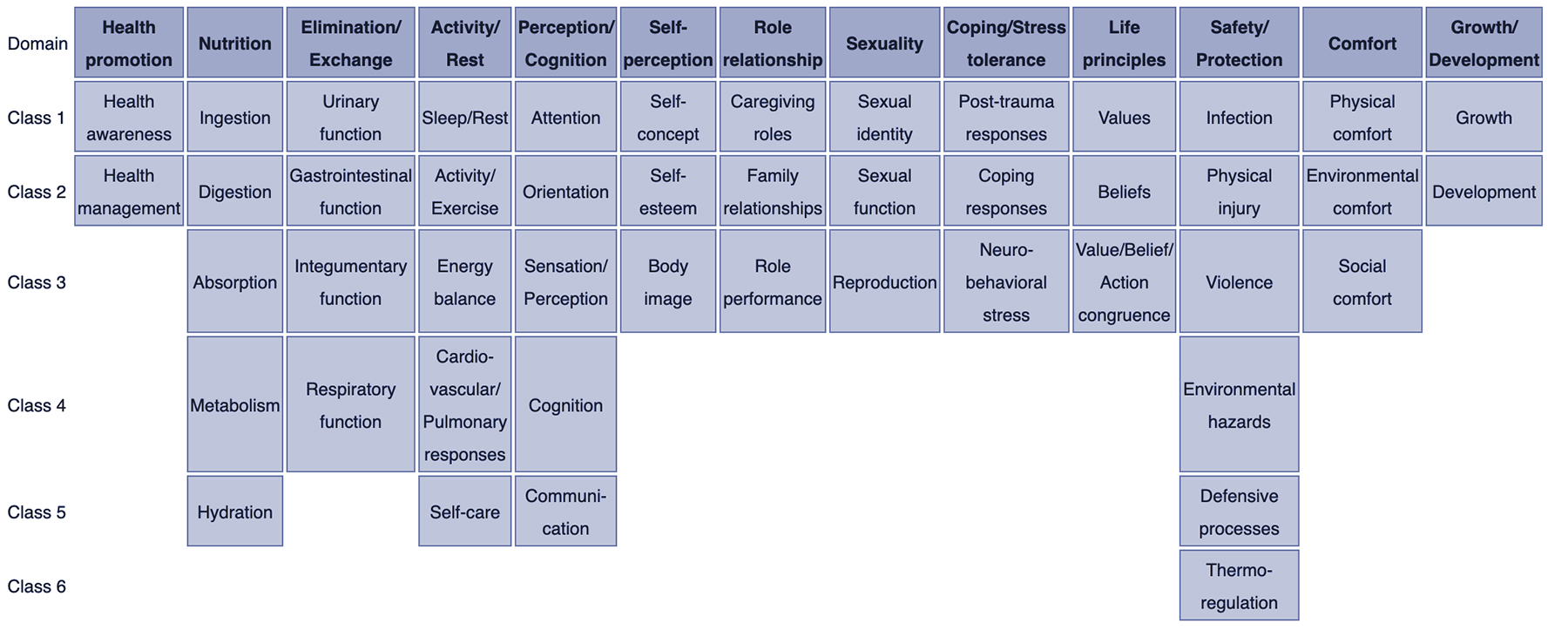
- Domain 1. Wellness Promotion
- Form 1. Wellness Sensation
- Class 2. Health Management
- Domain 2. Nutrition
- Form 1. Ingestion
- Course 2. Digestion
- Class 3. Assimilation
- Course 4. Metabolism
- Class 5. Hydration
- Domain 3. Elimination and Exchange
- Class 1. Urinary function
- Class 2. Gastrointestinal function
- Class iii. Integumentary part
- Course 4. Respiratory function
- Domain four. Activity/Rest
- Course ane. Sleep/Rest
- Form 2. Activeness/Exercise
- Class 3. Energy remainder
- Course 4. Cardiovascular/Pulmonary responses
- Class five. Self-care
- Domain 5. Perception/Cognition
- Course 1. Attention
- Grade 2. Orientation
- Class 3. Awareness/Perception
- Class 4. Knowledge
- Form v. Communication
- Domain half dozen. Cocky-Perception
- Class 1. Cocky-concept
- Grade two. Cocky-esteem
- Class iii. Body image
- Domain 7. Part relationship
- Class 1. Caregiving roles
- Class 2. Family relationships
- Form 3. Role performance
- Domain eight. Sexuality
- Class ane. Sexual identity
- Course 2. Sexual function
- Course 3. Reproduction
- Domain ix. Coping/stress tolerance
- Class one. Postal service-trauma responses
- Class ii. Coping responses
- Form iii. Neurobehavioral stress
- Domain 10. Life principles
- Class 1. Values
- Class 2. Behavior
- Form three. Value/Belief/Activeness congruence
- Domain 11. Safety/Protection
- Class 1. Infection
- Class 2. Physical injury
- Class 3. Violence
- Class 4. Environmental hazards
- Class 5. Defensive processes
- Course half-dozen. Thermoregulation
- Domain 12. Condolement
- Class 1. Physical comfort
- Course 2. Ecology comfort
- Class iii. Social comfort
- Domain 13. Growth/Development
- Class one. Growth
- Grade 2. Development
Nursing Procedure
The five stages of the nursing process are assessment, diagnosing, planning, implementation, and evaluation. All steps in the nursing procedure crave disquisitional thinking past the nurse. Apart from the understanding of nursing diagnoses and their definitions, the nurse promotes awareness of defining characteristics and behaviors of the diagnoses, related factors to the selected nursing diagnoses, and the interventions suited for treating the diagnoses.
The steps, importance, purposes, and characteristics of the nursing process is discussed more in item here: "The Nursing Process: A Comprehensive Guide"
Types of Nursing Diagnoses
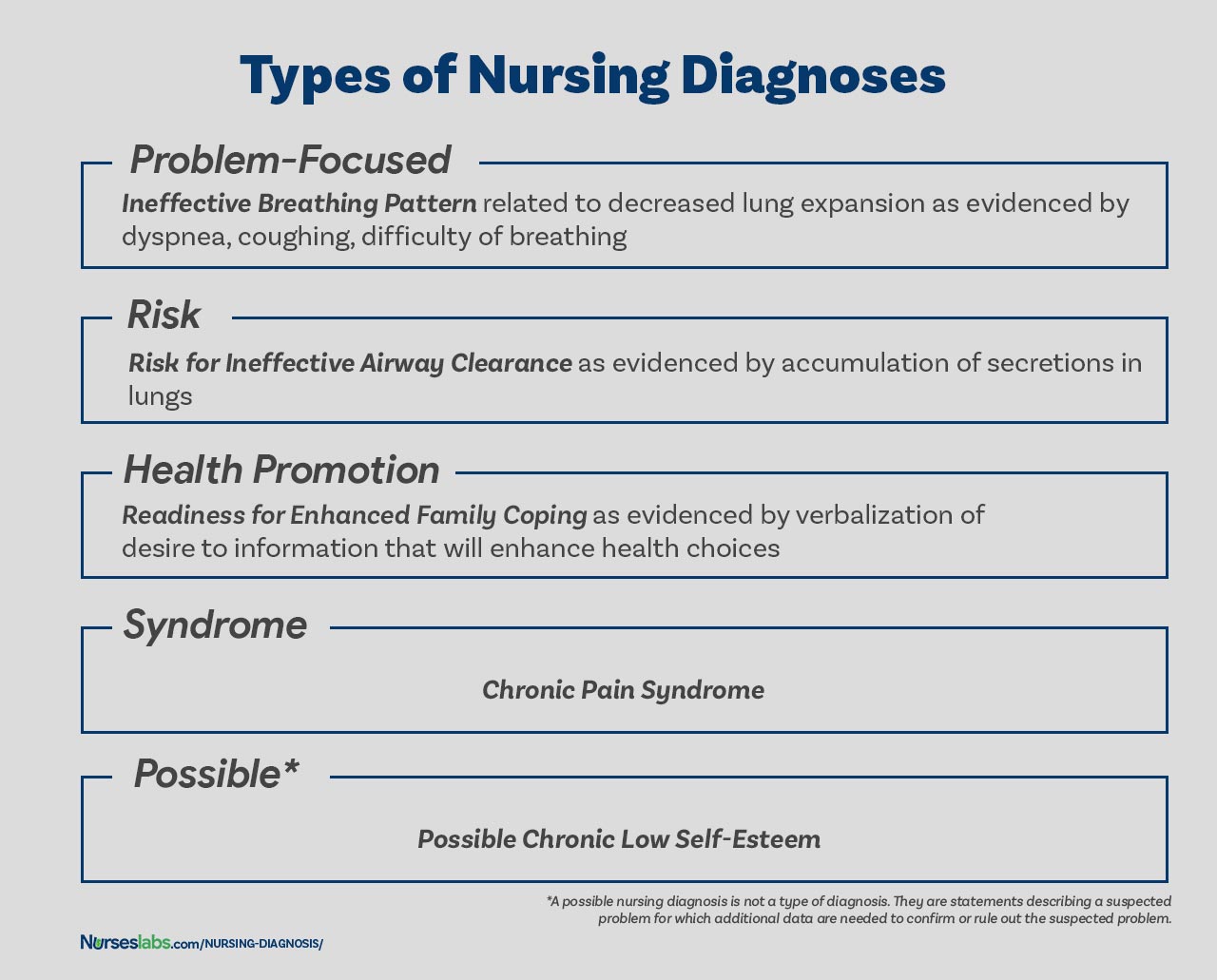
The four types of NANDA-I nursing diagnosis are Actual (Problem-Focused), Risk, Wellness Promotion, and Syndrome. Here are the four categories of nursing diagnoses provided by the NANDA-I organization.
Problem-Focused Nursing Diagnosis
A trouble-focused diagnosis (too known as actual diagnosis) is a customer trouble that is present at the time of the nursing assessment. These diagnoses are based on the presence of associated signs and symptoms. Actual nursing diagnosis should not be viewed every bit more than of import than risk diagnoses. There are many instances where a chance diagnosis can be the diagnosis with the highest priority for a patient.
Trouble-focused nursing diagnoses have three components: (one) nursing diagnosis, (2) related factors, and (3) defining characteristics. Examples of actual nursing diagnosis are:
- Ineffective Breathing Pattern related to pain as evidenced by pursed-lip breathing, reports of pain during inhalation, employ of accessory muscles to breathe
- Anxiety related to stress as evidenced past increased tension, anticipation, and expression of business concern regarding upcoming surgery
- Astute Pain related to decreased myocardial flow every bit evidenced by grimacing, expression of pain, guarding behavior.
- Impaired Skin Integrity related to pressure level over bony prominence as evidenced by pain, bleeding, redness, wound drainage.
Risk Nursing Diagnosis
The second type of nursing diagnosis is called risk nursing diagnosis.These are clinical judgments that a trouble does not exist, just the presence of risk factors indicates that a problem is likely to develop unless nurses intervene. There are no etiological factors (related factors) for risk diagnoses. The individual (or group) is more susceptible to developing the problem than others in the aforementioned or a similar situation because of hazard factors. For example, an elderly client with diabetes and vertigo who has difficulty walking refuses to inquire for assistance during ambulation may be accordingly diagnosed with Gamble for Injury.
Components of a risk nursing diagnosis include (1) risk diagnostic label, and (2) risk factors. Examples of adventure nursing diagnosis are:
- Risk for Falls equally evidenced by muscle weakness
- Hazard for Injury as evidenced by contradistinct mobility
- Take chances for Infection as evidenced past immunosuppression
Wellness Promotion Diagnosis
Health promotion diagnosis (likewise known as wellness diagnosis) is a clinical judgment most motivation and desire to increment well-being. Health promotion diagnosis is concerned with the private, family, or community transition from a specific level of health to a higher level of health. Components of a health promotion diagnosis generally include only the diagnostic label or a one-part statement. Examples of wellness promotion diagnosis:
- Readiness for Enhanced Spiritual Well Existence
- Readiness for Enhanced Family Coping
- Readiness for Enhanced Parenting
Syndrome Diagnosis
A syndrome diagnosis is a clinical judgment concerning a cluster of trouble or risk nursing diagnoses that are predicted to present because of a certain situation or issue. They, also, are written every bit a one-part statement requiring only the diagnostic label. Examples of a syndrome nursing diagnosis are:
- Chronic Pain Syndrome
- Mail-trauma Syndrome
- Frail Elderly Syndrome
Possible Nursing Diagnosis
A possible nursing diagnosis is non a type of diagnosis every bit are bodily, risk, health promotion, and syndrome. Possible nursing diagnoses are statements describing a suspected problem for which additional data are needed to confirm or dominion out the suspected problem. It provides the nurse with the power to communicate with other nurses that a diagnosis may be present but additional information collection is indicated to rule out or confirm the diagnosis. Examples include:
- Possible Chronic Low Self-Esteem
- Possible Social Isolation.
Components of a Nursing Diagnosis
A nursing diagnosis has typically three components: (one) the problem and its definition, (2) the etiology, and (3) the defining characteristics or gamble factors (for risk diagnosis).

Problem and Definition
The problem statement, or the diagnostic label, describes the client's health trouble or response for which nursing therapy is given as concisely as possible. A diagnostic characterization usually has two parts: qualifier and focus of the diagnosis. Qualifiers (besides called modifiers) are words that have been added to some diagnostic labels to give boosted significant, limit, or specify the diagnostic statement. Exempted in this rule are ane-word nursing diagnoses (east.thousand., Anxiety, Constipation, Diarrhea, Nausea, etc.) where their qualifier and focus are inherent in the one term.
| Qualifier | Focus of the Diagnosis |
|---|---|
| Deficient | Fluid volume |
| Imbalanced | Diet: Less Than Body Requirements |
| Impaired | Gas Substitution |
| Ineffective | Tissue Perfusion |
| Chance for | Injury |
Etiology
The etiology, or related factors, component of a nursing diagnosis characterization identifies one or more likely causes of the wellness problem, are the weather involved in the development of the problem, gives direction to the required nursing therapy, and enables the nurse to individualize the client'south care. Nursing interventions should be aimed at etiological factors in order to remove the underlying cause of the nursing diagnosis. Etiology is linked with the trouble statement with the phrase "related to" such as:
- Decreased activity tolerance related to generalized weakness.
- Impaired physical mobility related to imposed bed rest.
Risk Factors
Risk factors are used instead of etiological factors for risk nursing diagnosis. Run a risk factors are forces that put an private (or grouping) at an increased vulnerability to an unhealthy condition. Risk factors are written post-obit the phrase "as evidenced by" in the diagnostic statement.
- Risk for Falls as evidenced by old historic period and utilize of walker.
- Adventure for Infection as evidenced past suspension in pare integrity.
Defining Characteristics
Defining characteristics are the clusters of signs and symptoms that bespeak the presence of a particular diagnostic characterization. In bodily nursing diagnoses, the defining characteristics are the identified signs and symptoms of the client. For take a chance nursing diagnosis, no signs and symptoms are present therefore the factors that cause the customer to exist more susceptible to the problem form the etiology of a take a chance nursing diagnosis. Defining characteristics are written following the phrase "as evidenced by" or "as manifested by" in the diagnostic argument.
Diagnostic Process: How to Diagnose
There are three phases during the diagnostic process: (1) data analysis, (2) identification of the customer'due south health bug, health risks, and strengths, and (3) formulation of diagnostic statements.
Analyzing Information
Analysis of information involves comparing patient data against standards, clustering the cues, and identifying gaps and inconsistencies.
Identifying Health Problems, Risks, and Strengths
In this conclusion-making step after information assay, the nurse together with the customer identify bug that back up tentative bodily, risk, and possible diagnoses. It involves determining whether a problem is a nursing diagnosis, medical diagnosis, or a collaborative problem. Also at this stage is wherein the nurse and the client identify the customer's strengths, resources, and abilities to cope.
Formulating Diagnostic Statements
Formulation of diagnostic statements is the last step of the diagnostic process wherein the nurse creates diagnostic statements. The procedure is detailed below.
How to Write a Nursing Diagnosis?
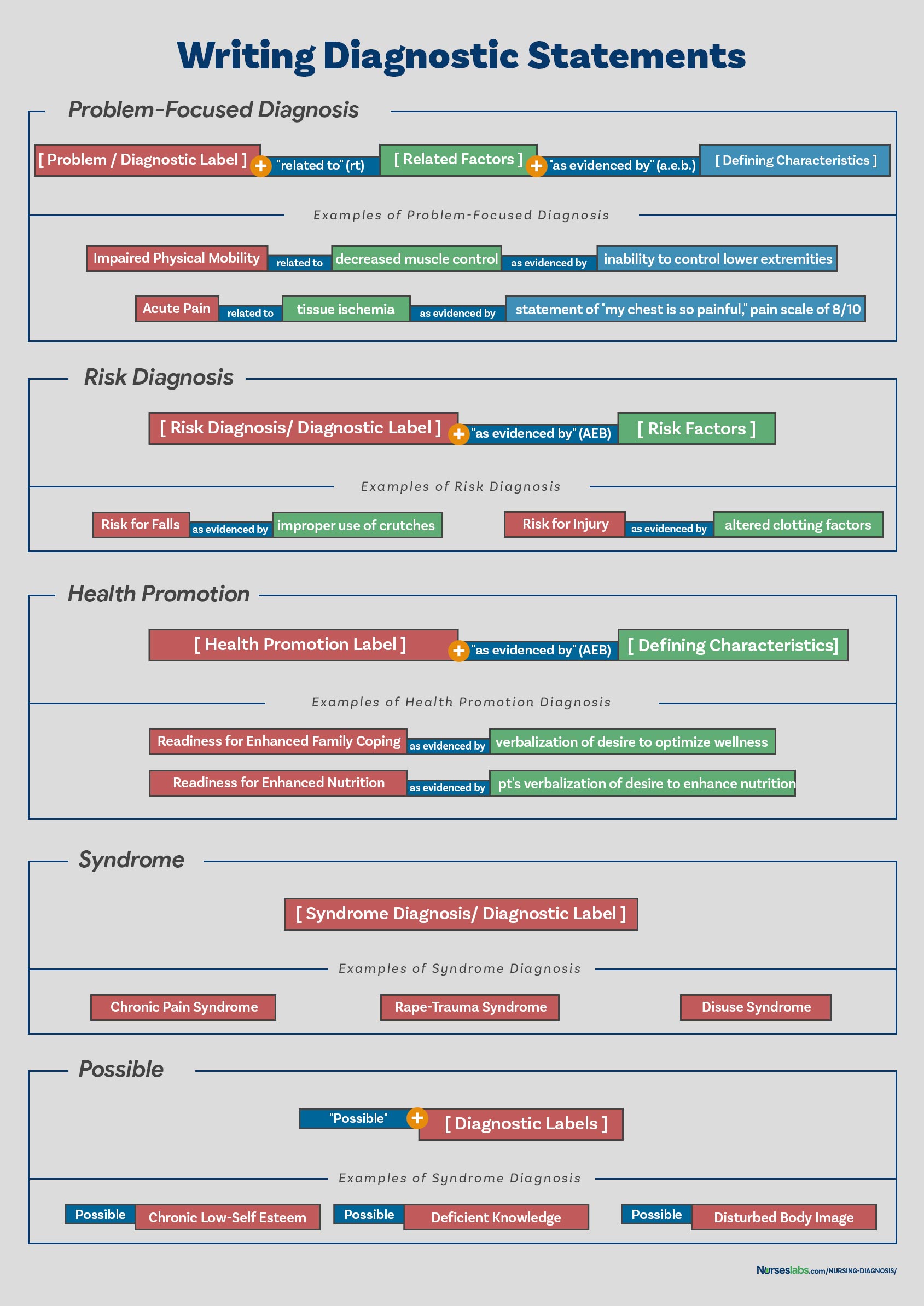
In writing nursing diagnostic statements, depict the health condition of an private and the factors that have contributed to the status. You do non demand to include all types of diagnostic indicators. Writing diagnostic statements vary per type of nursing diagnosis (see below).
Pes Format
Another way of writing nursing diagnostic statements is past using the Foot format which stands for Trouble (diagnostic label), Etiology (related factors), and Signs/Symptoms (defining characteristics). Using the PES format, diagnostic statements can exist one-function, ii-part, or 3-office statements.
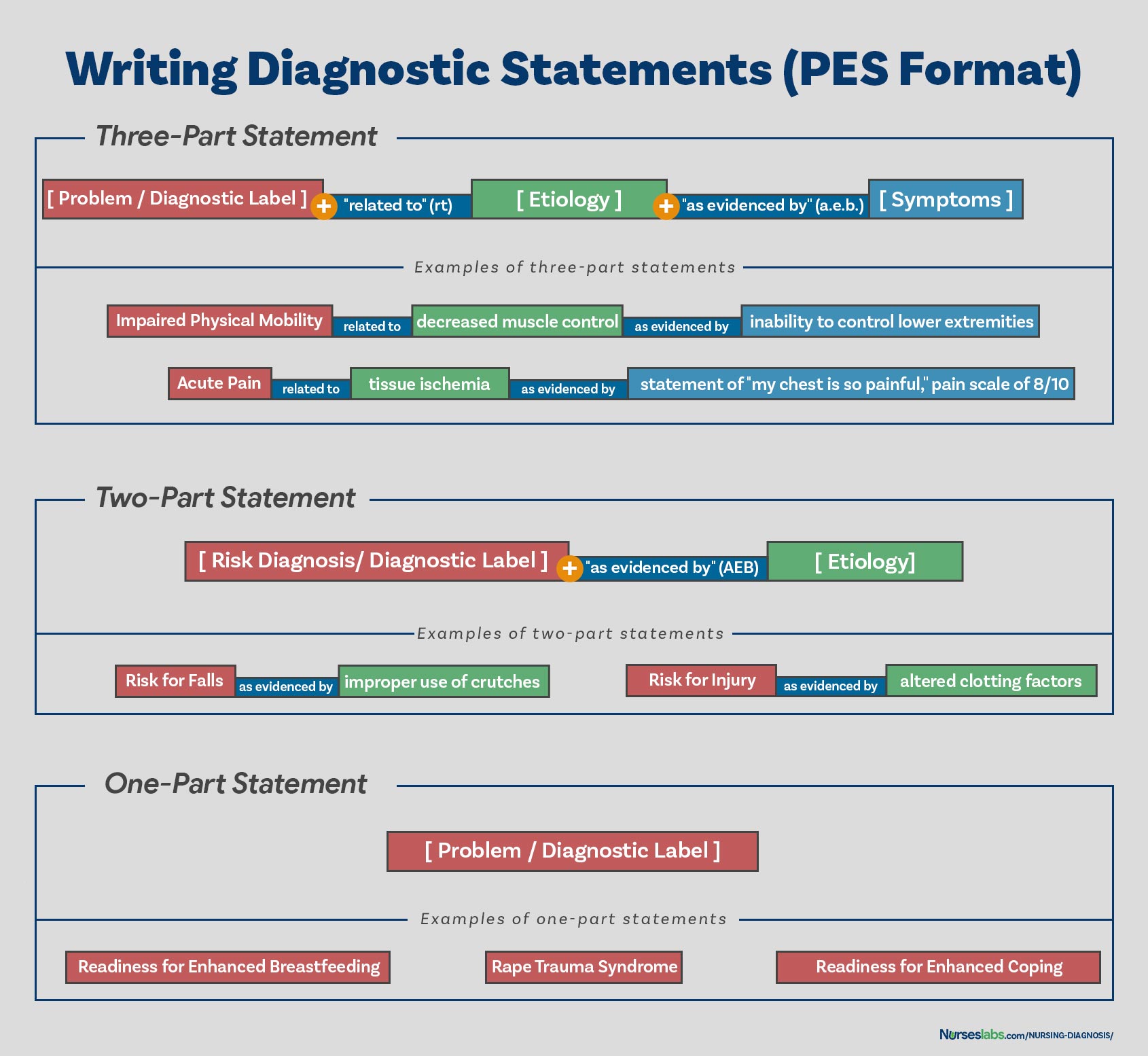
One-Part Nursing Diagnosis Argument
Health promotion nursing diagnoses are usually written as one-part statements considering related factors are e'er the same: motivated to reach a higher level of wellness through related factors may be used to improve the chosen diagnosis. Syndrome diagnoses too have no related factors. Examples of one-part nursing diagnosis statements include:
- Readiness for Enhance Breastfeeding
- Readiness for Enhanced Coping
- Rape Trauma Syndrome
Ii-Part Nursing Diagnosis Statement
Risk and possible nursing diagnoses take ii-role statements: the get-go part is the diagnostic label and the 2d is the validation for a risk nursing diagnosis or the presence of take a chance factors. It'due south not possible to have a tertiary role for risk or possible diagnoses because signs and symptoms do not be. Examples of two-part nursing diagnosis statements include:
- Risk for Infection as evidenced by compromised host defenses
- Risk for Injury as evidenced past abnormal claret contour
- Possible Social Isolation related to unknown etiology
Three-part Nursing Diagnosis Argument
An bodily or problem-focus nursing diagnosis has three-role statements: diagnostic label, contributing factor ("related to"), and signs and symptoms ("as evidenced by" or "every bit manifested by"). The three-part nursing diagnosis statement is also called the Foot format which includes the Problem, Etiology, and Signs and Symptoms. Examples of iii-office nursing diagnosis statements include:
- Impaired Physical Mobility related to decreased muscle control as evidenced past inability to control lower extremities.
- Acute Pain related to tissue ischemia as evidenced by statement of "I experience severe hurting on my breast!"
Variations on Bones Statement Formats
Variations in writing nursing diagnosis argument formats include the post-obit:
- Using "secondary to" to divide the etiology into two parts to make the diagnostic argument more descriptive and useful. Post-obit the "secondary to" is often a pathophysiologic or affliction process or a medical diagnosis. For example, Risk for Decreased Cardiac Output related to reduced preload secondary to myocardial infarction.
- Using "complex factors" when there are likewise many etiologic factors or when they are too circuitous to state in a cursory phrase. For example, Chronic Low Cocky-Esteem related to complex factors.
- Using "unknown etiology" when the defining characteristics are present but the nurse does non know the cause or contributing factors. For example, Ineffective Coping related to unknown etiology.
- Specifying a second office of the full general response or NANDA label to make information technology more precise. For example, Impaired Peel Integrity (Right Anterior Chest) related to disruption of skin surface secondary to burn injury.
Nursing Diagnosis for Care Plans
This section is the list or database of the common NANDA nursing diagnosis examples that you can utilize to develop your nursing intendance plans.
- Activity Intolerance
- Astute Pain
- Anxiety
- Chronic Pain
- Constipation
- Decreased Cardiac Output
- Deficient Fluid Book
- Deficient Knowledge
- Diarrhea
- Backlog Fluid Volume
- Fatigue
- Fright
- Grieving
- Hopelessness
- Hyperthermia
- Hypothermia
- Imbalanced Diet: Less Than Body Requirements
- Impaired Gas Exchange
- Impaired Tissue (Skin) Integrity
- Impaired Urinary Elimination
- Ineffective Airway Clearance
- Ineffective Breathing Pattern
- Ineffective Tissue Perfusion
- Chance for Falls
- Risk for Impaired Peel Integrity
- Adventure for Infection
- Risk for Injury
- Hazard for Unstable Claret Glucose Level
- Run into more than sample nursing care plans here.
You can find the complete list of nursing diagnoses and their definitions at NANDA International Nursing Diagnoses: Definitions & Classification 2018-2020 11th Edition.
References and Sources
References for this Nursing Diagnosis guide and recommended resources to farther your reading.
- Ackley, B. J., & Ladwig, G. B. (2010).Nursing Diagnosis Handbook-E-Book: An Evidence-Based Guide to Planning Care. Elsevier Health Sciences.
- Berman, A., Snyder, S., & Frandsen, Yard. (2016).Kozier & Erb'south Fundamentals of Nursing: Concepts, process and exercise. Boston, MA: Pearson.
- Edel, Yard. (1982). The nature of nursing diagnosis. In J. Carlson, C. Craft, & A. McGuire (Eds.), Nursing diagnosis (pp. iii-17). Philadelphia: Saunders.
- Fry, V. (1953). The Creative arroyo to nursing. AJN, 53(iii), 301-302.
- Gordon, Thousand. (1982). Nursing diagnosis: Process and application. New York: McGraw-Hill.
- Gordon, M. (2014).Manual of nursing diagnosis. Jones & Bartlett Publishers.
- Gebbie, K., & Lavin, M. (1975.) Classification of nursing diagnoses: Proceedings of the Beginning National Conference. St. Louis, MO: Mosby.
- McManus, R. 50. (1951). Assumption of functions in nursing. In Teachers College, Columbia University, Regional planning for nurses and nursing education. New York: Columbia University Press.
- For the Consummate List of NANDA-I Nursing Diagnosis: Herdman, H. T., & Kamitsuru, S. (Eds.). (2017). NANDA International Nursing Diagnoses: Definitions & Classification 2018-2020. Thieme.
- NANDA. International. (2014).Nursing Diagnoses 2012-14: Definitions and Nomenclature. Wiley.
- Powers, P. (2002). A soapbox assay of nursing diagnosis. Qualitative health research, 12(7), 945-965. [Scribd]
Source: https://nurseslabs.com/nursing-diagnosis/
Belum ada Komentar untuk "How Can You Determine the Quality of the Nursing Research"
Posting Komentar